Finny, the English Department Instructor
Straight ManFinny, the English Department Instructor, becomes one of the central organizers of the effort to remove William Henry Devereaux Jr. as chair of the English Department. He is persistent, politically alert, and convinced that the department’s conflict is serious business rather than another bout of its habitual disorder. As the university’s budget and labor crisis deepens, his influence extends from the internal recall campaign to the faculty’s consideration of a strike. The campaign gives him leverage, but its eventual defeat leaves him facing the budget cuts he has tried to resist.
Identity and Political Position
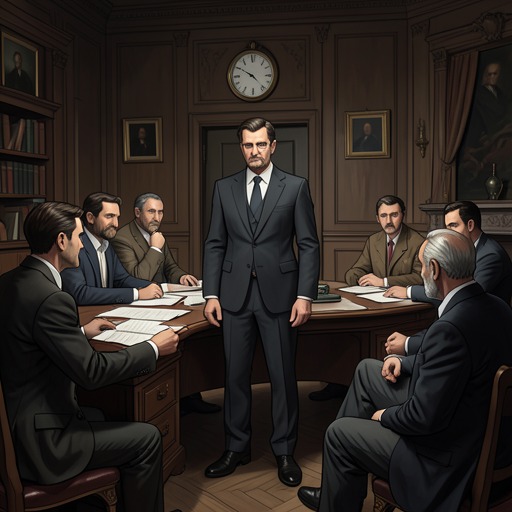
The available evidence presents Finny, the English Department Instructor, chiefly through his actions in departmental politics. He repeatedly checks William Henry Devereaux Jr.’s intentions, helps mobilize colleagues against him, and later presides over a recall meeting in the chair’s absence. His activity is not merely personal opposition: he treats the removal proceedings as consequential business and is concerned that the English Department has long been regarded as a joke by the wider university community.
The department’s political divisions make Finny’s position difficult to separate from the friendships and grievances around him. When Herbert Schonberg approaches William Henry Devereaux Jr. about the union’s cause, he says he has already spoken with Teddy Barnes and June Barnes, who have aligned with Paul Rourke and Finny. William Henry Devereaux Jr. finds this striking because those colleagues have not previously sided together in that way. The alignment suggests how the threat of institutional change has temporarily reorganized relationships that normally sustain the department’s gridlock.
The Campaign to Remove the Chair
Finny is among the people seeking William Henry Devereaux Jr.’s removal. Billy Quigley invokes the impending recall while trying to pressure William Henry Devereaux Jr. into helping him, claiming that he will vote with Finny and an unnamed Jesuit if he does not get his way. William Henry Devereaux Jr. recognizes Billy’s threatened vote as a lie, but the appeal still shows how the recall has become a weapon in personal bargaining as well as a formal departmental process.
Finny’s role in the campaign is visible in his repeated visits to the chair’s office. He comes in every fifteen minutes to see whether William Henry Devereaux Jr. has returned, a small but insistent display of attention during an unsettled period. On the day of the meeting, he asks what William Henry Devereaux Jr. intends to do and makes clear that the proceedings are meant to remove him from both the office and the chairmanship. He wants to know whether the chair will attend, while also making plain that his private preference is for him to stay away. Finny fears that William Henry Devereaux Jr.’s presence would turn the proceedings into farce, and he insists that the department’s business be treated seriously.
The chair is told that charges and grievances will be discussed and that he would have an opportunity, perhaps an obligation, to respond. Finny nevertheless emphasizes how little support he is likely to receive. Teddy Barnes and June Barnes separately urge William Henry Devereaux Jr. not to accept the situation passively, arguing that a denial could split the department again and return it to its familiar stalemate. Finny’s position is different: he wants a meeting whose purpose is not dissolved by another performance of the department’s old divisions. William Henry Devereaux Jr. agrees not to attend and may vote by proxy, leaving Finny to chair the meeting in the absent chair’s place.
Union Politics and the Strike Threat
Finny’s organizing extends beyond the recall. During the faculty’s response to proposed cuts, he spends an afternoon on the phone and gets colleagues worked up. Teddy Barnes tells William Henry Devereaux Jr. that Finny believes the union has several votes to spare, and that June Barnes thinks he is right. The vote is governed by the department’s operating paper, which requires a two-thirds majority. The rule makes the struggle more than a contest of rhetoric: Finny must assemble enough support to carry a formal decision.
At the university level, the faculty union considers a strike as leverage against the budget crisis. Herbert Schonberg explains that a strike vote is being called to prevent seniors from graduating, an action intended to create political pressure near the end of the term. Finny is later identified as among those directly affected by the coming budget cuts and as someone whose position is supported by the union’s call for a strike. His activism therefore has a direct stake: he is not simply arguing about institutional principles from a safe distance, but confronting a process that may affect his own professional future.
The strike does not prevail. After Dickie Pope is dismissed and Jacob Rose, a longtime acquaintance respected by the faculty, becomes chief executive officer, the faculty votes overwhelmingly against striking. The decision rejects the position urged by the faculty union and works against the interests of those, including Finny, who will be affected by the following year’s budget reductions. The shift in leadership and the faculty’s response alter the balance of the conflict that Finny had been trying to shape.
Reversal and Uncertain Ending
Finny’s last appearance is markedly different from the image of the determined organizer. He is sitting on the steps of William Henry Devereaux Jr.’s deck, crying, dressed in plain slacks and a button-down shirt rather than his customary white suit. At his feet lies a flattened white bundle that William Henry Devereaux Jr. gradually recognizes as a sheet marked with dark spots. The circumstances of the bundle and the reason for Finny’s tears are not yet established in this moment.
William Henry Devereaux Jr. first assumes that Finny is grieving over his academic fate. He also considers whether Finny has come to see their changed fortunes as a basis for renewed alliance, but that is the chair’s interpretation, not a confirmed account of Finny’s purpose. The faculty’s rejection of the strike and the coming cuts give the scene a clear political context without resolving its personal meaning. Finny’s arc thus moves from repeated visits, strategic alignment, and command of a recall meeting to an image of distress outside the home of his longtime adversary. The contrast leaves his prospects open while showing how quickly institutional power can shift, even for someone who has worked hard to organize it.